
Author: O.K. Hogan | REALTOR®/BROKER, CCIM, SFR
If you are buying your first coastal home, you are going to hear a few terms that may be new to you: flood zone, Base Flood Elevation, first-floor height, and Elevation Certificate.
They are connected, but they are not interchangeable. And in my experience, that is where buyers sometimes get confused.
A flood map tells you about the mapped flood hazard at a location. Base Flood Elevation tells you how high floodwater is expected to reach during the base flood. An Elevation Certificate gives you information about the elevation and characteristics of the specific building. Then there is the flood insurance quote, which tells you what coverage for that particular property may cost.
I tend to look at these the same way I look at any set of numbers: understand what each number is telling you before you make a decision based on it.
That matters here on the Crystal Coast. A home in Beaufort, Morehead City, Atlantic Beach, Emerald Isle, or elsewhere in Carteret County should be evaluated by its exact address and structure. I would not make a decision based on what the neighbor pays for flood insurance or because the lot looks high from the street.
North Carolina buyers can start with the official North Carolina Flood Risk Information System to research a specific property. If you are still learning the coastal buying process, our guide to broader coastal home-buying due diligence covers several other questions worth answering before closing.
Flood Zones: What AE and VE Mean for Coastal Buyers
FEMA flood maps divide properties into zones based on the type and level of mapped flood hazard.
Zones beginning with A or V are generally within a Special Flood Hazard Area, or SFHA. That is an area subject to the 1%-annual-chance flood.
According to the NFIP's official flood-zone guidance, Zone AE is a high-risk flood area where detailed analysis has established Base Flood Elevations. Zone VE is a coastal high-hazard area that also accounts for hazards associated with storm-driven waves.
That additional wave exposure is important.
Federal floodplain-management standards for coastal high-hazard areas include special elevation, foundation, and below-floor requirements for new construction and substantial improvements in V and VE zones. Qualifying new or substantially improved structures in VE zones generally must be elevated on pilings or columns, and the space below the lowest floor is restricted.
Zone X is different. It generally represents areas outside the mapped high-risk Special Flood Hazard Area, although Zone X designations can represent different levels of flood risk.
I would not interpret Zone X to mean "no flood risk." That is not what it means.
The other mistake I would avoid is treating AE, VE, and X as if they were insurance price categories.
Your flood zone is important, but the zone letter alone does not tell you what your flood insurance will cost.
That is why I want buyers to understand the property before drawing conclusions from the map.
What Is Base Flood Elevation?
Base Flood Elevation, usually shortened to BFE, is the elevation associated with the base flood; the flood that has a 1% chance of being equaled or exceeded in any given year.
FEMA's Base Flood Elevation definition describes it as the expected surface-water elevation for that flood event.
You may also hear people call this the "100-year flood." I am not especially fond of that phrase because it can give buyers the wrong impression.
It does not mean that level of flooding happens only once every 100 years. It means there is a 1% chance of that level being equaled or exceeded in any given year.
BFE is also not the same thing as the elevation of the ground beneath the house.
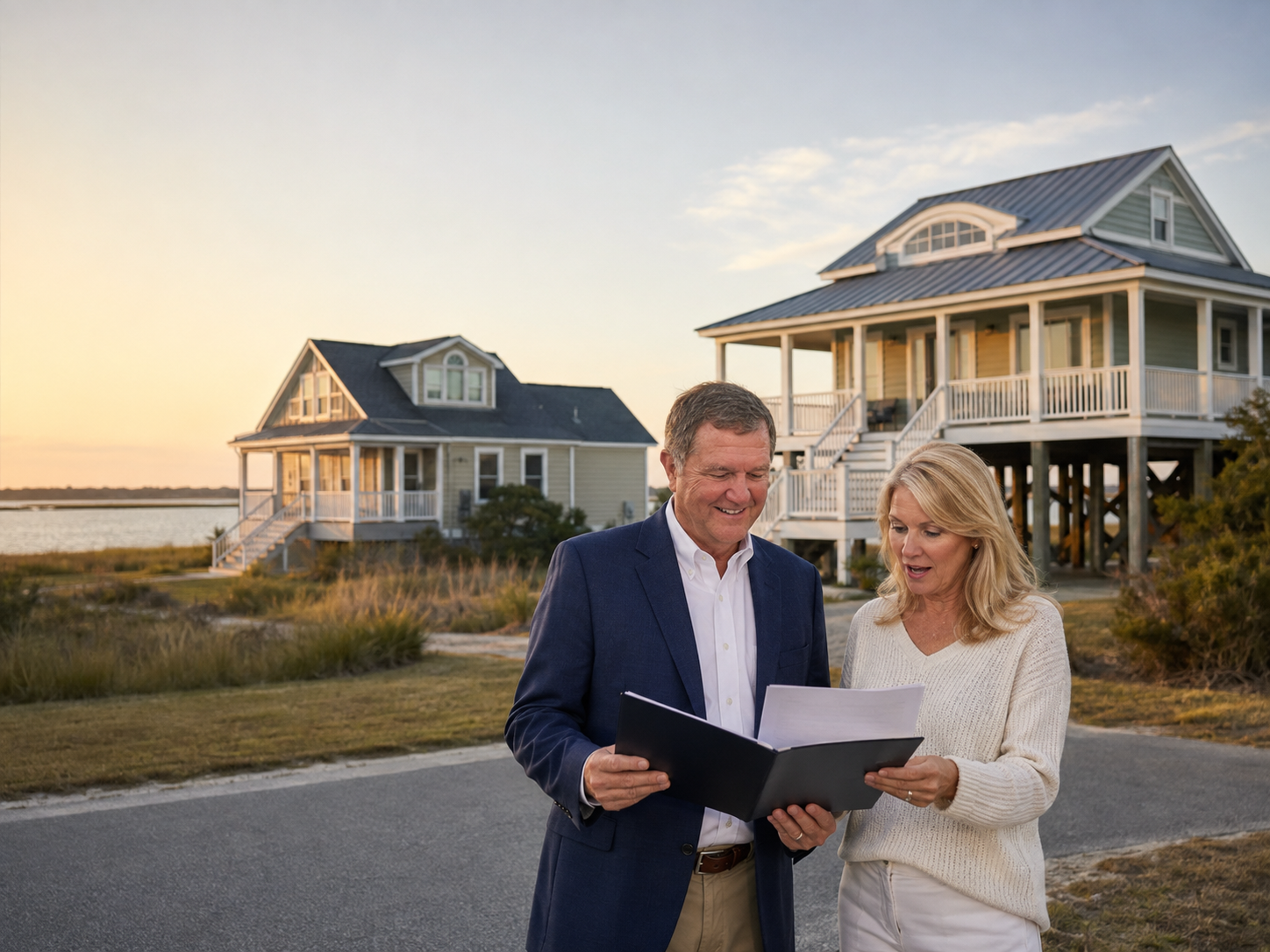
That distinction becomes very easy to see when you look at coastal properties side by side. One home may sit on a slab. The house next door may have a crawlspace. Another may be elevated on pilings or columns.
From the road, those properties may look fairly similar. From a flood-risk standpoint, they may not be similar at all.
I have been coming to Carteret County for decades, and one thing you learn is that coastal property can change considerably over a short distance. Around Bogue Sound, the Newport River, Bogue Banks, Core Sound, and the surrounding waterways, I would rather examine the individual property than make assumptions based on the neighborhood.
When you are physically looking at homes, it also helps to know what to check during a coastal home tour instead of concentrating only on the view and the listing description.
What Is an Elevation Certificate?
An Elevation Certificate, or EC, documents information about a specific building.
That is the key point. It is building-specific information, not simply another flood-zone map.
The NFIP's Elevation Certificate guidance explains that the certificate can document the building's location, characteristics, flood-zone information, and elevation information, including First Floor Height.
For a buyer, an EC can help put the pieces together.
You may be able to see how the structure is elevated, identify important building characteristics, and compare what exists on the property with the flood information you have already reviewed.
There is also an important insurance distinction.
An Elevation Certificate does not, by itself, determine your NFIP flood insurance premium.
That is worth emphasizing because buyers still sometimes hear otherwise.
Most homeowners do not need an Elevation Certificate simply to purchase NFIP coverage. FEMA can use other data to determine building characteristics, including First Floor Height. However, an existing EC may provide more accurate or more favorable information about a property, and an owner can submit it for consideration.
So I would think of the Elevation Certificate as another useful piece of the property's financial and physical picture, not as a document that automatically produces an insurance rate.
Do You Need a New Elevation Certificate?
Not necessarily.
Before spending money on a new Elevation Certificate, I would first find out whether one already exists.
FEMA recommends checking with the local floodplain manager. The seller may also have a copy from a previous purchase, insurance transaction, permit, construction project, or survey.
An older Elevation Certificate is not automatically worthless just because it is old.
What matters is whether it still accurately describes the house you are considering.
If there has been an addition, an enclosed lower area, a foundation change, a substantial improvement, or other meaningful construction since the certificate was prepared, I would want to know whether the existing EC still reflects the structure accurately.
I would also compare the information with the flood map currently in effect. Flood maps can change. That is one reason I prefer official mapping tools over relying on an old listing sheet or paperwork passed from one owner to another.
If you do need a new Elevation Certificate, use a qualified licensed professional authorized to complete it under applicable requirements.
I would also avoid budgeting around a generic internet estimate for the cost or timing. Properties are different, providers are different, and schedules change. Get the actual number for the property you are considering.
How Flood Zones and Elevation Affect Flood Insurance
Flood insurance is another area where I prefer an actual quote over an assumption.
Elevation can matter because a better-elevated structure may present a different flood risk than a lower one. But elevation is not the only consideration, and the flood-zone designation alone is not enough to calculate what you will pay.
That means two homes in the same AE zone can receive different insurance quotes.
It also means the seller's current premium is not automatically your premium. Neither is the amount the neighbor says he pays.
When I am helping someone evaluate a coastal property, I want the insurance number for that house.
Building characteristics, location, mitigation features, coverage selections, and other property-specific information can affect the quote. You are making a financial decision, so use property-specific numbers whenever you can get them.
If you are considering waterfront property around Morehead City, our guide to property-specific flood insurance costs in Morehead City goes further into the insurance questions I think buyers should ask.
Will Your Lender Require Flood Insurance?
Possibly, and this is a question I would raise early.
Your lender's requirement and your insurance premium are two separate issues.
The NFIP's flood insurance eligibility and mortgage guidance explains that federal flood-insurance requirements apply in certain situations when a property is located in a Special Flood Hazard Area and the mortgage is federally backed. A lender may also have requirements beyond the federal minimum.
Do not wait until you are near closing to find that out.
Ask the lender what will be required for the specific property and loan you are considering.
If you plan to use private flood insurance instead of an NFIP policy, I would also confirm that the policy will satisfy the lender before you count on it as part of your financing.
When Should You Check Flood Risk Before Buying?
As early as you reasonably can.
I am not saying every buyer needs to order a new Elevation Certificate before writing an offer. I am saying that flood risk, insurance, and elevation are financial questions, and financial questions are most useful when you still have time to act on the answers.
Start with the flood zone. Find out whether an Elevation Certificate exists. Get an insurance quote when appropriate. Ask the lender what will be required.
If a new Elevation Certificate could materially change how you view the property, find out what it would take to obtain one.
The last thing I want is for a buyer to discover an important number after most of the decisions have already been made.
North Carolina real estate contracts also have specific deadlines, fees, deposits, and termination provisions. Do not assume that discovering a flood-related concern automatically means every payment connected with the transaction will be returned.
Know your contract. Know your deadlines. And get the information you need while it can still help you make the decision.
Coastal Home Flood-Risk Checklist
- Check the exact property address. Use the North Carolina Flood Risk Information System and official FEMA mapping resources rather than relying only on a real estate portal.
- Confirm which flood map is effective. Preliminary mapping can be useful, but it should not be confused with the regulatory map currently in effect.
- Ask whether an Elevation Certificate already exists. Check with the seller and, when appropriate, the local floodplain office.
- Look at the actual building. Pay attention to the foundation, enclosed lower areas, flood openings, utilities, mechanical equipment, stairs, additions, and other improvements.
- Get a property-specific flood insurance quote. Do not build your budget around what someone next door pays.
- Confirm the lender's requirements. Do this before you are deep into underwriting.
- Check floodplain and permit requirements before making improvement plans. This is especially important if you expect to renovate, enclose lower space, add onto the house, or substantially improve the property.
Flood exposure is only one part of evaluating a waterfront property. Our guide to waterfront home due diligence beyond flood risk covers other issues such as docks, water access, shoreline conditions, permits, and long-term ownership considerations.
What to Check When Comparing Coastal Listings
This is where the numbers become useful.
You may have two homes a few blocks apart with similar square footage and similar asking prices. Their flood considerations can still be quite different.
Start with the flood zone, but do not stop there.
Look at the actual structure. Review any available Elevation Certificate. Check the effective flood map. Look at the foundation and lower-level enclosures. Then get an insurance quote for the address.
I pay particular attention when a coastal home has enclosed space below the primary living level.
Depending on the flood zone and how the home was constructed, that area may be restricted to certain uses, such as parking, building access, or storage. If someone is presenting that space as an ordinary finished living area, I would want to understand exactly what I was looking at before assigning value to it.
Renovations deserve the same attention.
If the house has changed substantially since an older Elevation Certificate was prepared, the certificate may no longer tell the entire story.
None of these things automatically makes the property a bad buy.
That is an important distinction.
When I find something unusual in the numbers or the structure, I do not immediately conclude that we should walk away. I conclude that we have another question to answer.
That is a much better way to approach coastal real estate.
Why Local Coastal Real Estate Experience Matters
I was a regular visitor to Carteret County for more than 30 years before Lugean and I permanently moved to Beaufort in 2000.
That gave me the opportunity to see this area first as someone coming from outside and later as someone who lives here. Those are two different perspectives, and both have been useful when helping people buy coastal property.
I am also a retired professional accountant and a Certified Commercial Investment Member, or CCIM.
I naturally tend to look beyond whether a home is attractive. I want the numbers to make sense too.
Flood exposure, insurance, financing, property condition, and long-term ownership costs all become part of that analysis. A beautiful view is important. It just should not be the only thing you evaluate.
Over the years, I have seen plenty of coastal homes that appear similar from the road but look very different once you begin examining the details.
That is why I would rather have a buyer ask one more question before closing than discover one important answer afterward.
Frequently Asked Questions
What is the difference between Flood Zone AE and Flood Zone VE?
Zone AE is a high-risk flood area with established Base Flood Elevations. Zone VE is a coastal high-hazard area that also includes storm-wave hazards. Because of that additional wave exposure, VE zones generally have stricter floodplain construction requirements.
Does an Elevation Certificate determine my flood insurance premium?
No. An Elevation Certificate does not set your NFIP flood insurance premium. It provides building-specific information that may help FEMA or an insurer evaluate the property's flood characteristics more accurately.
Do I need an Elevation Certificate to buy flood insurance?
Usually not for NFIP coverage. Most homeowners can obtain NFIP coverage without an Elevation Certificate, although an existing EC may provide useful building-specific information and may affect how the property is evaluated.
Can I use the seller's old Elevation Certificate?
Possibly. I would first make sure it still accurately describes the house you are buying. If the home has been altered, improved, enclosed, or expanded since the certificate was prepared, additional review may be necessary.
Does a higher house always mean cheaper flood insurance?
No. Elevation can matter, but it does not guarantee a lower premium. Flood insurance pricing can also depend on the property's location, building characteristics, mitigation features, coverage choices, and other property-specific information.
Do I need flood insurance if the home is in Zone X?
A Zone X property may not be subject to the federal mandatory-purchase requirement that applies to certain financed properties in Special Flood Hazard Areas. But Zone X does not mean zero flood risk, and a lender may still require coverage. I recommend checking both the property and the lender's requirements before making that decision.
The Bottom Line for Coastal Home Buyers
If you remember only one thing from this article, remember that a flood zone, Base Flood Elevation, Elevation Certificate, insurance quote, and lender requirement are not the same thing.
Each tells you something different about the property.
For a Crystal Coast buyer, I recommend checking the exact address, reviewing the effective flood information, finding any existing Elevation Certificate, understanding how the structure is built, getting a property-specific insurance quote, and confirming the lender's requirements.
Do not substitute the neighbor's insurance premium, the appearance of the lot, or one flood-zone letter for that work.
The goal is not to eliminate every home that has some flood exposure. We live on the coast. The goal is to understand the exposure and decide whether the property still makes sense for you.
That is a decision I would rather make with the numbers in front of me.
If you are considering a home in Beaufort, Morehead City, Atlantic Beach, Emerald Isle, Pine Knoll Shores, Cape Carteret, or elsewhere along the Crystal Coast, Star Team Real Estate can help you work through those questions property by property.
Call Star Team Real Estate at (252) 727-5656 when you are ready to evaluate a coastal home with both the numbers and the view in front of you. You can also explore Crystal Coast homes for sale as you begin comparing properties.
Disclaimer: This article is for general educational purposes and is not legal, engineering, surveying, environmental, or permitting advice. Regulations and site conditions can change. Confirm requirements for a specific parcel and proposed project with the appropriate government agencies and qualified professionals.
Check out this article next