
Author: Lugean Hogan, REALTOR®/BROKER, ABR, CLHMS
After more than 40 years in Carteret County, and years spent working with customers at my family’s Jones Brothers Marine business, I have learned something important about waterfront property: never assume the water access you see is the water access you can create.
A beautiful shoreline on Bogue Sound, Core Sound, Back Sound, or the Newport River may look perfect for a dock. But whether you can actually build one depends on the property, the waterway, the proposed structure, and the regulations that apply.
If a dock, boat lift, or private boating access matters to your purchase, I recommend treating it as something to verify, not something to assume.
For a broader look at waterfront due diligence, our Coastal North Carolina waterfront buyer’s playbook explains many of the questions worth answering before you close.
Can You Build a Dock on Crystal Coast Waterfront Property?
Not necessarily.
One of the easiest mistakes to make when looking at waterfront property is assuming that owning the shoreline automatically gives you permission to build the dock you want.
It does not.
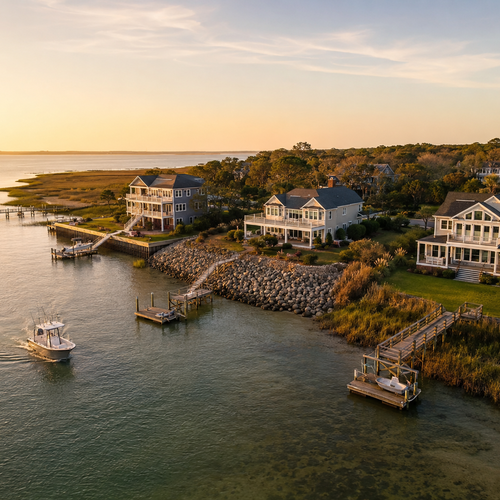
A house next door may have a pier, boat lift, or large docking platform while your property faces completely different conditions. Water depth, shoreline shape, riparian boundaries, navigation, environmental resources, and existing permits can all affect what may be allowed.
That is why I encourage buyers to look closely at phrases such as “dock potential,” “deep-water access,” or “possible pier.” They are among the coastal listing terms buyers should verify before making a purchase decision based on water access.
The view may be obvious. The dock rights usually require more homework.
When Is a CAMA Permit Required for a Dock?
CAMA stands for the Coastal Area Management Act. It is part of North Carolina’s framework for managing development in designated coastal areas, including Carteret County.
CAMA permitting becomes important when development is proposed within an Area of Environmental Concern, commonly called an AEC. The North Carolina statutory definition of the coastal area and the state’s CAMA permitting requirements and exemptions establish the legal framework.
For Crystal Coast buyers, the practical takeaway is that many new docks, piers, and related structures extending into estuarine or public trust waters require CAMA authorization.
The exact permit depends on the parcel and project.
It is also important to remember that CAMA is not necessarily the only approval involved. Local, state, and federal requirements may also apply.
New Docks, Piers, and Boat Lifts
Many private residential docking projects can be reviewed under North Carolina’s general-permit standards when the project meets the applicable requirements.
Those standards address matters such as dock dimensions, setbacks, navigation, waterway width, environmental resources, and placement. North Carolina publishes the standing CAMA general permit standards for piers and docking facilities.
I would not look at one maximum dimension in those rules and assume that is what you will be allowed to build.
The site itself matters. A dock that works on one property may not work the same way just a few lots away.
Dock Repairs and Replacement
An older dock deserves its own set of questions.
North Carolina law provides exemptions for certain qualifying repairs and reconstruction of docks, piers, and walkways when specific statutory conditions are met. That does not mean every repair, expansion, or replacement is automatically exempt.
If I were helping a buyer evaluate a waterfront home with an aging pier, I would want to know more than whether the dock looks usable today. I would also want to understand what happens when the structure eventually needs substantial repair.
That can matter a great deal after closing.
What CAMA Reviews Before Approving a Dock
Dock permitting is rarely about one measurement or one rule.
Several conditions can affect what may be approved, and buyers should look at the entire waterfront situation rather than focusing only on whether there is room for a pier.
Pier Length and Dock Size
Under CAMA’s general-permit standards, a pier generally cannot extend more than 400 feet waterward of the normal high-water line or normal water level.
But 400 feet should not be read as a promise.
Established pier lengths, water depth, navigation, the width of the waterbody, and other conditions may result in a shorter structure.
The rules also address features such as walkway width and platform size. For buyers, these measurements are useful starting points, not substitutes for a parcel-specific determination.
Navigation and Waterway Width
This is where my boating background tends to come into the conversation.
Having permission for a dock is one thing. Having a dock that actually works for your boat is another.
The general-permit standards address navigation and generally restrict how far a docking facility can extend across a natural waterbody, canal, or basin. Additional considerations can apply around navigation channels.
So when a buyer tells me, “I need water access,” my next question is usually: What do you want to do with it?
A center-console boat, a shallow-draft skiff, and a larger offshore boat can have very different requirements.
Our guide to deep-water waterfront homes on the Crystal Coast explains why the practical boating question goes well beyond whether a dock exists.
Riparian Setbacks
Property boundaries do not simply stop being important when they reach the water.
Under CAMA’s general-permit standards, docking facilities generally must remain at least 15 feet from adjacent riparian property lines extended into the water, unless the applicable requirements allow otherwise.
That can become especially important on narrow lots or shorelines with unusual angles.
I would never recommend assuming that a pier can simply extend straight out from wherever it looks most convenient. The riparian layout needs to be understood first.
Water Depth, Shellfish, and Coastal Resources
Water depth is one of the first things boaters notice, but it is not the only environmental condition that matters.
Primary Nursery Areas, submerged aquatic vegetation, shellfish resources, and other protected coastal features can affect how a project is reviewed or designed.
Where shellfish cultivation may be involved, buyers can review the state’s shellfish lease and franchise information and then confirm the conditions affecting the specific property.
This becomes particularly important around Core Sound, Harkers Island, and Down East.
I have spent enough time around those waters to know that two properties that look similar from the road can offer very different experiences once you start talking about boats, depths, tides, and access. That is why Down East water access can change the way buyers evaluate coastal property.
Federal Navigation Channels
CAMA may not be the end of the permitting question.
The U.S. Army Corps of Engineers regulates certain activities in navigable waters and waters of the United States under federal law.
If a proposed structure could involve federal jurisdiction, buyers should review the standing U.S. Army Corps of Engineers North Carolina regulatory program and determine whether additional authorization is required.
The important point is simple: do not assume one approval covers everything.
Does a Neighbor’s Dock Mean You Can Build One?
No, and this is one of the assumptions I would most like waterfront buyers to avoid.
A neighboring dock tells you that a dock exists next door. It does not tell you what can be approved on your property.
That pier may have been permitted under different circumstances. The neighboring parcel may also have different water depth, shoreline geometry, riparian boundaries, navigation conditions, or environmental constraints.
When I am looking at waterfront property with a buyer, I am much more interested in this question:
What can be permitted on this parcel for the way you want to use the water?
That is the answer that matters after you own the home.
How to Check Dock Feasibility Before Buying
If private boating access is important to you, start asking questions early.
You do not want to discover after closing that one of the main reasons you bought the property cannot work the way you expected.
If you are already under contract, use the time available for property investigations to resolve material questions while your contractual rights remain. Your real estate or legal professional can help you understand the deadlines and terms of your particular agreement.
Before relying on a property for dock access, I would want answers to these questions:
- Is the property within a CAMA-regulated Area of Environmental Concern?
- Does an existing dock have permits or other supporting records?
- Where are the riparian boundaries?
- What is the usable water depth under the conditions that matter for your boat?
- Could the proposed dock interfere with navigation?
- Are shellfish resources or other environmental conditions involved?
- Could local or federal approvals also be required?
- Will the dock and water depth actually accommodate how you plan to use the property?
I also encourage buyers to be specific about the kind of waterfront they want. Oceanfront, soundfront, creekfront, canalfront, and other waterfront settings offer very different experiences.
Our guide to coastal waterfront property types can help you compare those differences.
What to Verify When a Property Already Has a Dock
An existing dock is certainly encouraging, but I still would not skip the research.
Ask for available permits, surveys, repair records, and other documents associated with the structure. If a pier or platform appears to have been enlarged or significantly changed, compare what you see with the available records.
Then look beyond permitting.
Pilings, decking, hardware, lifts, electrical systems, storms, saltwater exposure, and normal maintenance can all affect the cost of ownership. They belong in the broader conversation about the hidden costs of owning a Crystal Coast waterfront home.
If an active permit is involved, ask the Division of Coastal Management whether the sale or any future repair, modification, or unfinished work requires additional action.
The fact that a dock has been there for years is useful information. It is not a reason to stop asking questions.
Who to Contact About a CAMA Dock Permit
For a parcel-specific CAMA answer, go to the agency responsible for making that determination: the North Carolina Division of Coastal Management.
DCM provides information about permit types and the field representatives who work with property owners and applicants. Its CAMA permit types and field representative information is the best place to find current agency guidance without relying on an individual employee or phone extension that may change.
A knowledgeable real estate professional still has an important role.
We can help buyers identify the right questions, locate available records, coordinate due diligence, and understand whether the property fits the lifestyle they have in mind. But the permitting agency determines what regulations apply and what it will approve.
I think buyers are best served when everybody stays in the right lane.
At Star Team Real Estate, I bring more than 40 years of living in Carteret County, more than 10 years in real estate, and my experience managing sales and service at Jones Brothers Marine to the waterfront properties I help buyers evaluate. As a Certified Luxury Home Marketing Specialist, I also understand that with Crystal Coast waterfront homes, value is often tied not simply to the view but to how well the property actually supports the buyer’s intended use.
If you are deciding what kind of professional guidance you need, our waterfront property specialist guide for Coastal North Carolina buyers explains some of the expertise worth looking for.
Frequently Asked Questions
Do I need a CAMA permit to build a dock on the Crystal Coast?
In many cases, yes. A new dock, pier, boat lift, or similar structure in a CAMA-regulated Area of Environmental Concern on the Crystal Coast generally requires authorization from the North Carolina Division of Coastal Management. Permit requirements depend on the specific Carteret County property, waterway, and proposed project.
Does my neighbor’s dock mean I can build one too?
No. A neighboring dock does not guarantee that you can build a dock on your property. CAMA dock approval is parcel-specific and can depend on water depth, riparian boundaries, shoreline conditions, navigation, environmental resources, and previous permitting.
How close can a dock be to my neighbor’s property line?
CAMA general-permit standards generally require a dock to remain at least 15 feet from adjacent riparian property lines extended into the water. Exceptions or different configurations may apply in certain situations, so the proposed dock location should be confirmed for the specific waterfront property.
Can I repair or rebuild an existing dock without a new CAMA permit?
Sometimes. North Carolina law allows certain qualifying repairs or reconstruction of existing docks, piers, and walkways without a new CAMA permit when the statutory requirements are met. Expansions, significant alterations, or projects that do not qualify for an exemption may require additional approval.
Does a dock permit automatically transfer when I buy the property?
Do not assume that an existing dock permit automatically transfers with the property. Before buying a Crystal Coast waterfront home, ask the North Carolina Division of Coastal Management to confirm the permit’s status and whether the sale, unfinished work, future repairs, or modifications require additional action.
How long does it take to get a CAMA permit for a dock?
There is no single CAMA dock-permit timeline that applies to every Crystal Coast property. Review time depends on the permit type, proposed dock design, site conditions, and whether other local, state, or federal approvals are required. Buyers should contact the Division of Coastal Management early in their waterfront-property due diligence.
Buying Crystal Coast Waterfront Property With Confidence
Living on the water is one of the things I love about Carteret County. But buying waterfront property successfully means looking beyond the view.
If a dock matters to you, verify the parcel, water depth, riparian boundaries, existing records, environmental conditions, proposed use, and permitting requirements before depending on that access.
I would much rather help a buyer uncover a limitation before closing than discover it after the property is theirs.
At Star Team Real Estate, we help Crystal Coast buyers understand not only what a waterfront property looks like, but how it may actually work for the life they want to live here.
If boating access, a private dock, or another waterfront feature is important to your search, call us at (252) 727-5656. We can help you know what questions to ask before you buy.
Disclaimer: This article is for general educational purposes and is not legal, engineering, surveying, environmental, or permitting advice. Regulations and site conditions can change. Confirm requirements for a specific parcel and proposed project with the appropriate government agencies and qualified professionals.
Check out this article next