
By Lugean Hogan, REALTOR®/BROKER, ABR, CLHMS
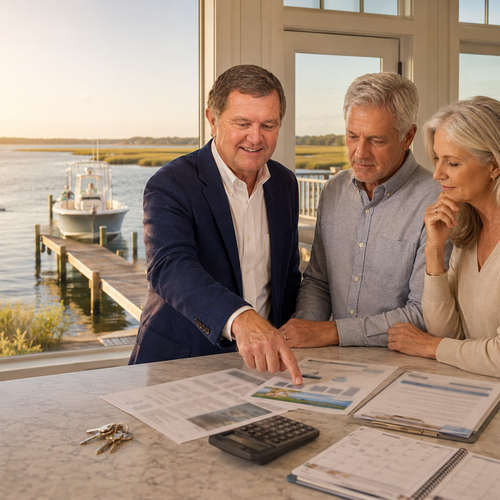
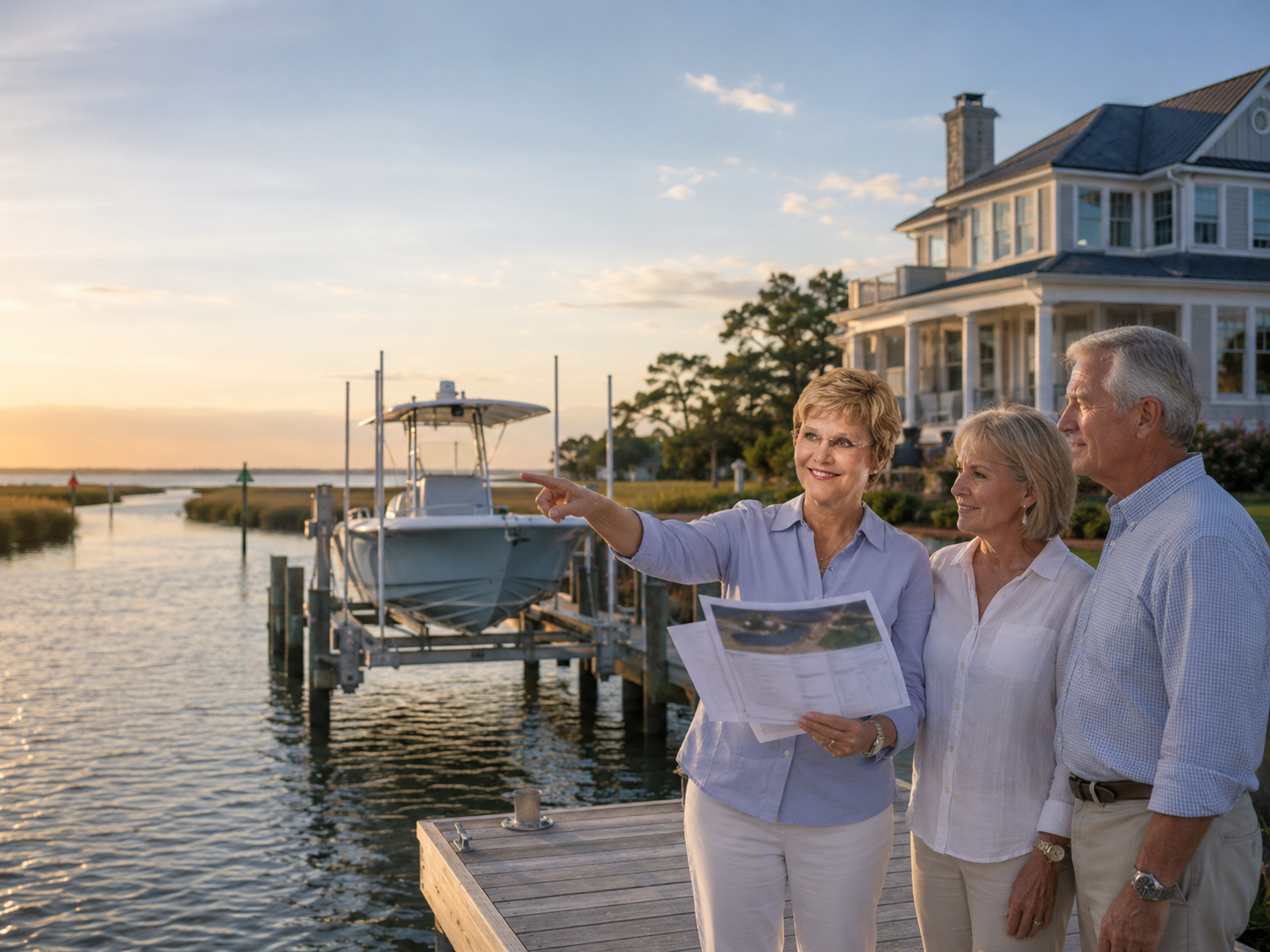
A waterfront home can have a gorgeous view and a beautiful dock without being the right property for your boat. I have seen buyers get excited about a house, only to discover that the water becomes too shallow, the channel is difficult to navigate, or the lift does not match the boat they own.
Here on the Crystal Coast, true boat access depends on more than being close to the water. You need usable depth at the dock, a clear route to navigable water, enough overhead clearance, and a legal dock that fits your vessel.
That is why I always tell boat-owning buyers to evaluate the water before they fall in love with the house.
What Deep-Water Access Means for Your Boat
“Deep water” is a phrase you will see in many waterfront listings, but it does not have one universal meaning. A depth that works well for a bay boat may not work for a larger center console, cruiser, or sportfishing boat.
A property has practical deep-water access when your boat can move safely from its slip to navigable water under the conditions in which you plan to use it.
The most important question is not, “Is this a deep-water property?” It is, “Will this property work for my boat?”
Depth at the Dock
Start by asking for measurements beside the dock, inside the slip, near the lift, and throughout the turning area. One reading at the end of the pier does not tell you everything you need to know.
A useful water-depth measurement should identify:
- The date and time
- The tide stage
- Recent wind and weather conditions
- The exact measurement location
- The method used
- The person who took the reading
Compare those measurements with official NOAA tide predictions and water-level observations. Tides matter, but they are not the only influence. Strong winds can raise or lower water levels in shallow sounds, creeks, and canals.
I would never rely on a seller’s memory or a casual measurement taken on a convenient afternoon. You want information that reflects the conditions in which you will actually use the boat.
The Shallowest Point Along the Route
The water beside the dock is only one part of the trip. Your boat must also pass through the slip entrance, turning basin, canal, creek, shared channel, and route to Bogue Sound, the Intracoastal Waterway, or the inlet you plan to use.
The shallowest point controls the route.
A property may have plenty of water at the dock but still be difficult to use because of a shallow canal entrance or a narrow bend farther away. That problem may not be visible during a showing.
Review the latest NOAA Electronic Navigational Charts and the current United States Coast Pilot. These official resources provide current navigation information, but they should still be paired with local measurements and professional guidance.
Private canals and residential dock approaches may not appear in enough detail on a chart. When the boat is a major part of the purchase, checking the full route is worth the effort.
Bridge and Overhead Clearance
Boat owners sometimes focus so closely on water depth that they forget about height.
A T-top, tower, hardtop, antenna, or outrigger can change which routes are practical. Check every fixed bridge, utility line, cable, and overhead obstruction between the property and your normal boating destination.
Use the boat’s maximum height with its equipment raised. Do not estimate from the cabin or hull alone.
Published bridge clearances can also be affected by water levels and chart updates. Always verify the route using current navigation information rather than an old printed chart, a listing description, or what someone remembers from years ago.
Dock Legality and Usability
A private dock can be one of the most valuable features of a waterfront home, but it can also become an expensive problem if it was altered without approval or does not fit the boat.
Confirm that the dock’s current configuration is permitted. Then determine whether it provides enough:
- Slip length and width
- Turning space
- Water depth
- Piling clearance
- Lift capacity
- Electrical service
- Shore-power access
- Protection from wind and wake
- Safe access between the house and boat
A permitted dock is not automatically right for every vessel. A dock can be completely legal and still be too narrow, too shallow, or poorly positioned for your needs.
Waterfront type matters too. Buyers who are still comparing locations may find it helpful to understand how oceanfront, soundfront, and canal homes support different coastal lifestyles.
Best Crystal Coast Areas for Deep-Water Homes
I have lived in Carteret County for more than 40 years, and one thing I have learned is that water access can change from one street to the next. Even properties in the same neighborhood may have very different channels, depths, dock conditions, and exposure.
Use the town or neighborhood as a starting point. Never use it as a guarantee.
Morehead City
Morehead City is often one of the first places serious boat owners consider. It provides access to Bogue Sound, the Newport River, the Intracoastal Waterway, and routes toward Beaufort Inlet.
Waterfront options can be found around Sugarloaf Island, The Moorings, Radio Island, Calico Creek, Pelletier Creek, Spooners Creek, and downtown Morehead City. Each area has its own advantages and limitations.
A property facing a larger body of water may offer a different experience from one farther inside a creek or residential canal. Buyers should review the exact route instead of assuming all Morehead City waterfront homes provide similar access.
For a closer look, read our guide to Morehead City neighborhoods with deep-water boat access.
Beaufort
Beaufort offers access to Taylor Creek, Town Creek, Gallants Channel, the Newport River, the Intracoastal Waterway, and routes toward Beaufort Inlet.
The setting may range from the historic waterfront near Front Street to properties around Lennoxville Point and waterways facing the Rachel Carson Reserve. The scenery can be wonderful, but buyers still need to study the individual dock and route.
Depth, wake exposure, current, and maneuvering space can change quickly between a main channel and a smaller creek. I would not assume that every Beaufort waterfront home will work for the same type of boat.
Swansboro and the White Oak River
Swansboro has a wonderful maritime character and offers access to the White Oak River, the Intracoastal Waterway, Bogue Sound, and routes toward Bogue Inlet.
A home along an established channel may provide a very different boating experience from one located farther inside a creek. Offshore boaters should pay special attention to the route they expect to use and current inlet conditions.
The location may be an excellent fit, but it needs to match how and where you actually boat.
Atlantic Beach and Pine Knoll Shores
Atlantic Beach and Pine Knoll Shores offer soundfront, canal-front, and marina-oriented properties along Bogue Banks.
Some homes have relatively direct access to Bogue Sound. Others depend on private canals, neighborhood channels, or canal entrances that may require maintenance.
Ask who is responsible for the canal, when it was last evaluated, and whether dredging has been needed. Also identify the shallowest point between the dock and the main boating route.
Cape Carteret and Cedar Point
Cape Carteret and Cedar Point sit near Bogue Sound, the Intracoastal Waterway, and the White Oak River.
These communities can work well for buyers who enjoy boating on the sound, river, or nearby coastal waterways. However, water outside marked or maintained channels can be shallow.
Wind also affects water levels in this part of the coast. A route that works well under one set of conditions may feel very different after sustained wind from another direction.
Harkers Island and Down East
Harkers Island and the Down East communities have a boating culture that is hard to separate from everyday life. Buyers are drawn to Core Sound, Back Sound, Cape Lookout, and the area’s fishing traditions.
The waterways include marked routes, narrow passages, shoals, and individual properties with very different dock conditions. Local knowledge is especially valuable here.
Buyers with tall boats, deep drafts, or unfamiliarity with these waters should evaluate the entire route before making an offer. A home can be close to excellent fishing while still requiring careful navigation.
How to Match a Deep-Water Property to Your Boat
Before my real estate career, I managed sales and service at Jones Brothers Marine, my family’s boat-building business. That experience taught me that two boats of similar length can have very different requirements.
Do not shop by length alone.
Before touring waterfront homes, write down your boat’s:
- Fully loaded draft
- Beam
- Length overall
- Maximum height
- Fully loaded weight
- Turning radius
- Shore-power requirements
- Preferred storage method
- Typical boating route
Dry weight is not the same as operating weight. Fuel, water, batteries, engines, equipment, fishing gear, and personal belongings all add pounds.
The lift, dock, and water should be evaluated using the boat as you will actually use it.
Plan for a Future Boat
I also encourage buyers to think honestly about what they may own five or ten years from now.
A dock that barely fits today’s boat could become limiting after an upgrade. On the other hand, paying a large premium for access you are unlikely to use may not be the smartest choice.
Look for practical flexibility. A wider slip, stronger lift, dependable channel, and good turning area may matter more than extra depth your boat does not need.
Complete Deep-Water Due Diligence
Deep-water due diligence may involve more people than a typical home purchase. Depending on the property, you may need help from a marine contractor, dock specialist, surveyor, electrician, qualified captain, insurance professional, attorney, or permitting authority.
Your real estate professional should help organize that process. However, no agent should pretend to replace those specialists.
Measure the Dock and Navigation Route
Request recent water-depth measurements at:
- The slip
- The boat lift
- The end of the dock
- The turning basin
- The canal or creek
- The canal entrance
- The shallowest point before navigable water
For a larger boat or a vessel with a deeper draft, consider running the route with a qualified local captain or marine professional.
Ask whether access changes during very low tides, long dry periods, seasonal wind patterns, or after major storms. Those conditions may tell you more than a single measurement taken on the day of the showing.
Inspect the Dock, Lift, and Shoreline
A standard home inspection may not fully evaluate a dock or other marine structures.
Ask qualified professionals to examine:
- Pilings and framing
- Decking and fasteners
- Ladders and cleats
- Electrical service
- Water connections
- Boat-lift motors and cables
- Lift bunks and cradle
- Bulkheads and seawalls
- Revetments or living shorelines
- Soil movement and washout
Confirm the lift’s manufacturer, capacity, age, and maintenance history. Make sure the rating is appropriate for the fully loaded boat, not just its advertised dry weight.
Waterfront ownership also includes expenses that may not be obvious during a showing. Our guide to the hidden costs of owning a Crystal Coast waterfront home can help you develop a more complete budget.
Review Channel-Maintenance Responsibility
One of the most important questions is also one of the easiest to overlook: who maintains the water between the dock and the public channel?
The responsibility may belong to:
- The individual property owner
- A homeowners association
- Several neighboring owners
- A municipality
- A state or federal agency
- Multiple parties with separate obligations
For a private or HOA-maintained channel, review the dredging history, reserve funds, permits, easements, agreements, and planned assessments.
Do not assume that past dredging guarantees future dredging. The next project may require new permits, funding, contractor availability, and cooperation among property owners.
Verify Dock, Dredging, and Shoreline Permits
Ask for the permits and approved plans covering the dock, lift, roofed structures, bulkhead, shoreline work, dredging, and previous repairs.
Then compare those documents with what is actually on the property. An original dock permit does not prove that later additions or storm repairs were also approved.
Review the current North Carolina CAMA permit requirements before assuming that a dock can be expanded, moved, covered, or rebuilt.
Federal authorization may also apply to docks, dredging, fill, wetlands, shoreline work, or construction in navigable waters. Consult the current U.S. Army Corps of Engineers North Carolina regulatory guidance and the appropriate permitting authorities before depending on a future improvement.
I always prefer to learn what is possible before closing, not after a buyer already owns the property.
Check Flood and Insurance Requirements
Do not wait until the final days of due diligence to investigate insurance.
Use the FEMA Flood Map Service Center to review the effective flood map and available revisions for the address. Then consider the map together with the home’s elevation, construction, utilities, road access, and claims history.
Request insurance quotes that address:
- The house
- Flood exposure
- Wind or named-storm exposure
- The dock
- The boat lift
- Bulkheads and shoreline structures
- Deductibles
- Exclusions
- Coverage limits
Ask specific questions about the dock and lift. Those structures may be excluded or covered under a lower limit than the house.
How Verified Water Access Affects Property Value
A listing can use the words “deep water,” but those words alone do not establish value.
Buyers usually feel more confident when a property has:
- Documented water depth
- A dependable route to navigable water
- Adequate overhead clearance
- A legally permitted dock
- A properly sized boat lift
- Sound marine structures
- Clear channel-maintenance responsibility
- Manageable flood and insurance costs
Uncertainty can have the opposite effect. Problems with the dock, channel, permits, lift, bulkhead, or maintenance agreements may reduce what a buyer is willing to pay.
I do not recommend relying on fixed price ranges in a guide like this. Waterfront values change with location, inventory, condition, water access, dock quality, and the market at the time of the purchase.
The water features should be evaluated just as carefully as the house.
Deep-Water Waterfront Home Buying Checklist
Before making an offer, ask these eight groups of questions:
- Depth: What is the measured depth at the slip, lift, turning area, and shallowest point along the route?
- Measurement: When were the readings taken, under what tide and weather conditions, and by whom?
- Boat fit: Does the slip, lift, turning area, route, and overhead clearance work for my fully loaded vessel?
- Maintenance: Who maintains the canal or channel, when was work last completed, and how will future costs be paid?
- Permits: Do the dock, lift, shoreline structures, dredging work, and previous repairs match the approved permits?
- Condition: What is the condition of the pilings, electrical system, lift, bulkhead, and shoreline?
- Risk: What flood, storm, access, and insurance concerns apply to this individual property?
- Future use: Can the dock or lift be modified if my needs change, and what approvals would be required?
A waterfront real estate professional should help obtain answers and coordinate the appropriate specialists. Our guide to choosing a Coastal North Carolina waterfront property specialist explains what that representation should look like.
Frequently Asked Questions
How deep does the water need to be for my boat?
The water must be deeper than your boat’s fully loaded draft, with an added safety margin recommended by the manufacturer or a qualified marine professional. Measure the depth at the slip, turning area, canal entrance, and shallowest point along the entire route to navigable water. The lowest usable depth matters more than the reading at the end of the dock.
Does deep-water access guarantee year-round boating?
No, a listing that advertises deep-water access does not guarantee year-round boating. Water depth can change with tides, wind, shoaling, storms, and channel maintenance. Buyers should verify recent depth measurements and confirm that the complete route works for their boat under the conditions in which they plan to use it.
Who should measure the water depth before I buy a waterfront home?
A qualified marine contractor, hydrographic surveyor, dock specialist, or experienced local captain can help measure water depth. The measurements should record the exact location, date, time, tide stage, wind conditions, and method used. For a deep-draft or high-value boat, a more detailed professional assessment may be appropriate.
Can a waterfront property lose usable water depth over time?
Yes, a waterfront property can lose usable depth because of shoaling, sediment movement, storms, erosion, vegetation, or reduced channel maintenance. A route that worked for a previous owner may not remain suitable without dredging or other maintenance. Buyers should review the channel’s history and determine who is responsible for maintaining it.
Who pays to dredge a private or neighborhood channel?
The property owner, homeowners association, neighboring owners, municipality, or another organization may be responsible for dredging. Buyers should review HOA documents, easements, maintenance agreements, reserve funds, permits, and past assessments before purchasing. Do not assume that a public agency will maintain a private canal or residential channel.
Can I expand the dock or install a larger boat lift after closing?
You may be able to expand a dock or install a larger lift, but approval is not guaranteed. The project may require CAMA, U.S. Army Corps of Engineers, local-government, and HOA authorization. Confirm what can legally be built before buying if the property only works with a future dock or lift modification.
Find the Right Crystal Coast Waterfront Home
The right deep-water home is not always the property with the longest dock or the most impressive listing photographs. It is the one where the boat fits, the route works, the permits are in order, and the long-term responsibilities make sense for you.
Star Team Real Estate brings together real estate experience and practical knowledge of the Crystal Coast’s boating lifestyle. I have lived in Carteret County for more than 40 years, served real estate clients for more than a decade, and earned the Certified Luxury Home Marketing Specialist designation. Before real estate, I managed sales and service at Jones Brothers Marine, my family’s Eastern North Carolina boat-building business.
That experience helps me recognize the questions that need to be asked about the home, dock, boat, and waterway. It does not replace a marine contractor, engineer, attorney, insurance professional, or permitting authority. It helps make sure the right experts are involved before the purchase becomes an expensive lesson.
You can explore Crystal Coast communities or learn how our Coastal North Carolina home-buying service supports buyers from the first property search through inspections and closing.
Call Star Team Real Estate at (252) 727-5656 before making an offer on a deep-water waterfront home. Tell us about your boat, where you want to go, and how you plan to enjoy the water. We will help you look beyond the view and determine whether the property truly fits the life you want to live.
Check out this article next