

Author: O.K. Hogan | REALTOR®/BROKER, CCIM, SFR
When you're looking at waterfront property on the Crystal Coast, a bulkhead can be easy to take for granted. It's there, it looks solid, and most buyers move on to the view, the dock, or the house.
I don't think that's the right way to look at it.
A bulkhead, riprap revetment, and living shoreline can all help stabilize waterfront property, but they do the job differently. They also come with different maintenance needs, permitting considerations, and long-term costs.
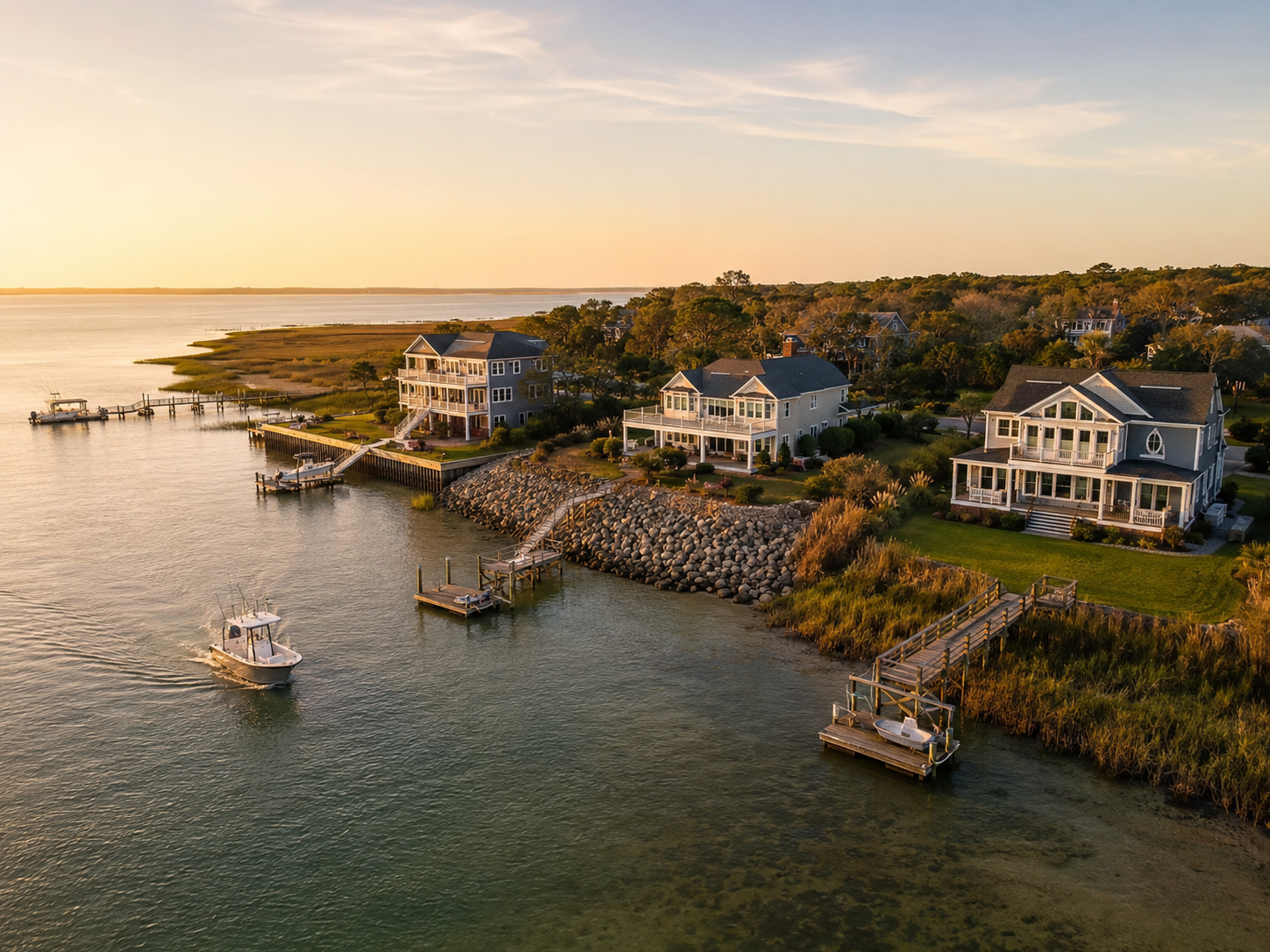
What you're really buying is not simply a wall, a pile of rock, or some marsh grass. You're buying a shoreline-management system that needs to fit that particular property.
And on the Crystal Coast, "that particular property" matters. Two homes can sit a short distance apart and still have very different wave exposure, erosion, water depth, bank conditions, and maintenance needs.
Bulkhead vs. Riprap vs. Living Shoreline
Here is the simplest way I know to compare the three.
| Method | What it is | How it works | Main trade-off |
|---|---|---|---|
| Bulkhead | A vertical retaining structure | Holds soil behind a hardened shoreline edge | Uses less horizontal space but creates a hard edge |
| Riprap | A sloped stone revetment | Absorbs and dissipates wave energy across the slope | Requires more shoreline footprint |
| Living shoreline | Vegetation alone or vegetation combined with features such as a marsh sill | Reduces wave energy, traps sediment, and stabilizes soil with roots | Works only where site conditions support the design |
The North Carolina shoreline stabilization options published by the Division of Coastal Management explain the different methods used along the state's estuarine shorelines.
Bulkheads
A bulkhead creates a nearly vertical edge between the water and the upland.
That can make good practical sense when usable yard space is limited. North Carolina's coastal guidance identifies bulkheads as durable structures that can be used in moderate- to higher-energy settings.
But a bulkhead is not something I would evaluate by appearance alone.
I'd want to know how the design handles soil retention, drainage, erosion around the ends of the wall, and the conditions immediately in front of it. A wall that looks fine from the yard may still deserve a closer look if the soil behind it is settling or the shoreline around it is changing.
Riprap
Riprap takes a different approach.
Instead of holding the shoreline with a vertical wall, it uses properly sized stone placed along a slope. That sloped surface helps absorb and dissipate wave energy as water reaches the bank.
North Carolina DCM notes that properly designed riprap can work across a wide range of wave conditions.
The trade-off is room. Riprap generally takes up more horizontal space than a bulkhead.
The stone itself also has to match the job. If you're evaluating an existing revetment, don't just ask whether the property "has riprap." Ask whether the stone has shifted, whether the slope still looks intact, and whether erosion is developing around it.
Living Shorelines
A living shoreline uses vegetation to stabilize the bank and reduce wave energy. Some designs also include a low sill that helps protect marsh vegetation.
Where the site is suitable, that vegetation can slow water, trap sediment, hold soil through its root system, and preserve more natural shoreline habitat.
I like the concept, but I would not choose one simply because it sounds like the environmentally friendlier answer.
The property still gets a vote.
If the site has more wave energy, wake exposure, current, or erosion than the design can handle, then a living shoreline may not be the right solution.
How Site Conditions Affect Shoreline Stabilization
This is where I think people sometimes get the order backward.
They decide they want a bulkhead, riprap, or a living shoreline and then try to make the property fit the choice.
I'd start with the property.
Wave energy, boat wakes, tidal current, the width of the waterbody, nearby channels, marsh vegetation, erosion history, wind exposure, storm conditions, and neighboring shorelines can all affect what works.
The North Carolina process for evaluating an estuarine shoreline recommends evaluating those site conditions before selecting a stabilization method.
That's also why I don't like broad rules such as, "Bogue Sound needs this," or, "Newport River needs that."
I've spent enough time around Carteret County to know that conditions can change considerably within the same body of water. The shoreline in front of the property is what matters.
When a Bulkhead May Make Sense
A bulkhead may make sense when the property needs a hardened retaining structure, has limited space for a sloped treatment, or faces conditions that call for a more substantial shoreline edge.
That doesn't mean every bulkhead should be designed the same way.
The bank, soil, water depth, erosion, drainage, structural support, and conditions around the ends of the wall all deserve attention.
When Riprap May Make Sense
Riprap may be a good fit when the property has enough room for a sloped revetment and absorbing wave energy makes more sense than creating a vertical edge.
A proper design should consider the stone size, slope, material underneath it, erosion pattern, and expected wave exposure.
If I'm buying a property with existing riprap, those are the things I want someone qualified to evaluate, not simply whether the rocks are still there.
When a Living Shoreline May Make Sense
A living shoreline may make sense where vegetation can establish successfully and the shoreline conditions are compatible with the design.
Some properties may support vegetation alone. Others may need a sill or another protective feature to reduce wave energy while the plants become established.
So the question I would ask is not:
"Which method do I like best?"
I'd ask:
"Which method fits this shoreline?"
That usually leads to a better decision.
What Does Shoreline Stabilization Cost?
This is where my accounting background tends to show up.
I don't like single-number answers when there are too many variables hiding behind the number.
There is no reliable Crystal Coast price per linear foot that applies to every bulkhead, riprap project, or living shoreline.
Access alone can change a job substantially. A contractor who can drive equipment into the yard is dealing with a different project from one who needs water-based equipment because the house, dock, landscaping, or terrain blocks access.
Other cost factors can include:
- Shoreline length
- Water depth and site conditions
- Materials
- Removal of an existing structure
- Site preparation
- Engineering or design work
- Equipment and mobilization
- Permitting
- Restoration after construction
- The final permitted design
That's why I'd be cautious about any article or contractor that gives you one universal "Crystal Coast bulkhead cost."
A better approach is to compare complete, site-specific proposals.
I would want the proposal to tell me what is included, what is not, who handles the permits, whether design or engineering work is included, how changes are priced, and what warranty comes with the work.
The shoreline is also only one line item in waterfront ownership. Before buying, it helps to look at the other long-term costs of Crystal Coast waterfront ownership rather than concentrating on the mortgage payment alone.
CAMA Permits for Bulkheads, Riprap, and Living Shorelines
Permitting is one of those subjects where assumptions can become expensive.
Work along coastal North Carolina shorelines may require CAMA authorization depending on the location, type of work, and proposed design.
North Carolina maintains different permitting pathways for coastal development. Which one applies depends on the individual project.
Before construction begins, I would check the North Carolina coastal permitting guidance and confirm the requirements with the Division of Coastal Management representative serving the property.
Bulkhead and Riprap Permits
North Carolina has permitting pathways for qualifying bulkhead and riprap projects.
That does not mean every bulkhead or revetment follows exactly the same process.
The location, design, environmental conditions, and other required approvals can change what is needed.
My advice here is simple: know the permit path before the contractor starts work, not afterward.
Living Shoreline Permits
Living shorelines can be a little confusing because people hear the word "natural" and assume that means "no permit."
That isn't a safe assumption.
Vegetation-only stabilization can be treated differently from a project involving fill, grading, stone, a sill, or other work in or along regulated waters.
Have DCM confirm what applies to the actual design being proposed.
Federal Shoreline Permits
CAMA may not be the end of the permitting discussion.
Some shoreline work can also fall under federal jurisdiction when construction, dredging, filling, or other activity affects navigable waters, wetlands, or other federally regulated waters.
The federal shoreline permitting program for North Carolina is administered by the U.S. Army Corps of Engineers' Wilmington District.
Before work begins, I would want clear answers to these questions:
- Which CAMA authorization applies?
- Could federal authorization also be required?
- Does the county or municipality require anything additional?
- Who is responsible for obtaining each permit?
- Will copies of the final permits stay with the property's records?
That last question matters if you eventually sell.
A permit that was handled correctly and documented is much easier for the next owner to understand than work where everyone is trying to reconstruct what happened years later.
Bulkhead, Riprap, and Living Shoreline Maintenance
The installation bill is only the first part of the story.
Once a shoreline system is there, it becomes another component of the property you need to watch and maintain.
Bulkhead Maintenance
Look for movement, bowing, soil settlement, gaps, erosion near the ends, or loss of soil behind the wall.
One thing I've learned in real estate is that small visible problems sometimes point to larger hidden ones.
If the ground is settling behind a wall, I wouldn't guess at the cause. I'd have someone qualified look at it.
Riprap Maintenance
Riprap is intended to be durable, but shorelines change.
After a significant storm or an unusual erosion event, look for displaced stone, exposed underlying material, changes in the slope, or erosion developing around the edges.
A few rocks being out of place may not be a major problem. A changing shoreline pattern deserves more attention.
Living Shoreline Maintenance
A living shoreline also needs to be watched.
Look for areas where vegetation has failed to establish, sections of the bank that continue to erode, or damage to a sill or other protective feature.
"Living" does not mean "install it and forget it."
Does Bulkhead Lower Flood Insurance?
I would not buy a bulkhead, or a house with one, assuming it will lower the flood-insurance bill.
Shoreline stabilization and flood insurance deal with different risks.
A bulkhead may help protect the edge of the property from erosion. Flood insurance, on the other hand, evaluates the risk of flood damage to the insured building.
The National Flood Insurance Program considers factors used to assess a property's flood risk, including location, proximity to flooding sources, ground elevation, and characteristics of the building.
So if somebody tells you a new bulkhead is going to save a certain amount on insurance, I'd ask to see the actual insurance quote.
Don't put hypothetical savings into your numbers.
Buyers looking in Carteret County can also read our guide to flood insurance considerations for Morehead City waterfront homes for a closer look at that side of waterfront ownership.
What Buyers Should Check Before Buying a Waterfront Property
When I'm looking at waterfront property, I want to know what comes with the house, not just what I can see from the back porch.
A newer bulkhead does not automatically make a property a good buy. An older one does not automatically make it a bad buy.
The condition and documentation tell you more.
Ask for any available:
- CAMA permits
- Federal authorizations
- Engineering or construction plans
- Contractor records
- Repair history
- Warranties
- Previous inspection information
- Documentation of significant erosion or storm damage
Then go outside and look at the shoreline.
Is the wall leaning? Is the ground settling behind it? Has the riprap shifted? Is erosion working around either end? Is the living shoreline established, or are there bare areas where the bank is still retreating?
Those are exactly the kinds of details worth adding to your shoreline items to check during a coastal home tour before you become the owner.
And don't let the listing language answer the question for you.
"New bulkhead," "protected shoreline," and "recent shoreline work" are useful descriptions, but they're also invitations to ask for the paperwork.
Why Crystal Coast Waterfront Expertise Matters
I've been coming to Carteret County for more than 30 years before moving permanently to Beaufort in 2000. I've seen this area first as someone coming in from outside and then as someone who lives here.
At Star Team Real Estate, I combine that local perspective with my CCIM designation, MBA, and background as a retired professional accountant when helping people evaluate waterfront real estate in Carteret County.
I tend to look at property the same way I looked at financial decisions for years: What are we really buying? What obligations come with it? What information are we missing? And what could cost us later if we don't ask about it now?
Shoreline stabilization fits that approach perfectly.
A REALTOR® should not pretend to be a coastal engineer, marine contractor, insurance agent, or permitting official. I certainly don't.
Our role is to recognize when something deserves a closer look, help the buyer ask the right questions, review the documentation that's available, and bring the proper professionals into the discussion when needed.
If you're buying near the water, it also helps to understand what a waterfront property specialist should help you evaluate before you make an offer.
Frequently Asked Questions
What is the main difference between a bulkhead, riprap, and a living shoreline?
A bulkhead is a vertical retaining structure, riprap is a sloped layer of stone that absorbs wave energy, and a living shoreline uses vegetation, sometimes with a protective sill, to stabilize the bank. The best shoreline stabilization method depends on wave exposure, erosion, available space, soil and bank conditions, and the property's permitting requirements.
Is riprap cheaper than a bulkhead?
Riprap is not always cheaper than a bulkhead. The total cost depends on shoreline length, site access, water depth, materials, equipment, design, permitting, and existing shoreline conditions. Property owners should compare complete, site-specific contractor proposals rather than relying on a general price per linear foot.
Can I install a living shoreline without a CAMA permit?
Whether a living shoreline requires a CAMA permit depends on the work being performed. Vegetation-only stabilization may be treated differently from projects involving fill, grading, stone, or a protective sill. Property owners should confirm the applicable requirements with the North Carolina Division of Coastal Management before beginning shoreline work.
Does every Crystal Coast property qualify for a living shoreline?
No, not every Crystal Coast property is suitable for a living shoreline. Suitability depends on wave energy, boat wakes, tidal currents, erosion, existing vegetation, shoreline shape, and available space. A site-specific shoreline assessment should determine whether a living shoreline can provide effective stabilization.
How do I know if an existing bulkhead needs repair?
Common signs that a bulkhead may need repair include leaning, bowing, soil settlement, loss of backfill, gaps, and erosion around the ends of the wall. These conditions can indicate localized damage or a larger structural problem. A qualified marine contractor or coastal engineer should evaluate the bulkhead before a buyer assumes it is in good condition.
What should I request before buying a property with shoreline stabilization?
Before buying a waterfront property with a bulkhead, riprap, or living shoreline, ask for all available permits, engineering or construction plans, contractor records, repair history, warranties, and inspection reports. Buyers should also investigate unresolved structural, erosion, or permitting questions during due diligence. Good documentation helps clarify what was installed, whether it was properly authorized, and what future maintenance may be required.
Buying a Crystal Coast Waterfront Property? Know What Comes With the Shoreline
A bulkhead, riprap revetment, and living shoreline can all be good solutions.
They just aren't good solutions for every property.
The right answer starts with the shoreline itself: wave exposure, erosion, available room, bank conditions, permitting, construction access, and the maintenance you're willing to take on.
If you're buying a Crystal Coast home that already has shoreline stabilization, don't stop when someone tells you, "It has a bulkhead."
Ask the next questions.
What was installed? When was it installed? Was it properly permitted? What condition is it in today? Has it been repaired? And what expense could be waiting for you down the road?
Those aren't glamorous questions, but they're the questions that can save you from an expensive surprise.
That's the kind of waterfront due diligence we help buyers think through at Star Team Real Estate. If you're comparing Crystal Coast waterfront properties and want another set of experienced eyes on what you're buying, call us at (252) 727-5656.
Check out this article next