
Author: O.K. Hogan | REALTOR®/BROKER, CCIM, SFR
Coastal listings can be exciting to read. They can also hide important details behind attractive wording. After visiting Carteret County for more than 30 years and living in Beaufort since 2000, I have learned that certain phrases in a coastal listing should never be accepted at face value.
That does not mean the property is a bad buy. It means the wording should lead to better questions before you move forward. Buyers who want a more structured process often benefit from learning how to buy a home without costly surprises and reviewing this practical guide on how to buy like a pro.
Why Certain Listing Words Matter More in Coastal Real Estate
Along the coast, vague listing language can raise bigger questions about flood exposure, insurance, access, and long-term ownership costs. According to NOAA’s annual high-tide flooding outlook, U.S. coastal communities are expected to face a national average of 55 to 85 high-tide flooding days per year by 2050. Zillow also found that homes with high flood risk were less likely to sell, took longer to go pending, and sold at larger discounts from initial list price than homes with low flood risk.
That is why wording matters so much in coastal real estate. A phrase that sounds harmless in a listing can point to questions that affect both your budget and your peace of mind. If you are just starting your search, it helps to compare listings across Crystal Coast and Wilmington communities so you can see how the same phrases are used in different markets.
Pro Tip: When a listing uses a polished but vague phrase, ask one simple question right away: What does that mean for this specific property?
What “As-Is” Can Really Mean in a Coastal Home Listing
“As-is” does not always mean the home is in poor condition. Sometimes it only means the seller does not want to make repairs. Still, in a coastal market, this phrase should prompt you to ask whether the home has deferred maintenance, prior water intrusion, storm-related damage, corrosion, or older major systems that may need attention.
A better approach is to ask for the seller's disclosure and the ages of the roof, HVAC, windows, and other major components. From the seller’s side, it can also help buyers understand how to sell a house as-is quickly so they can better interpret why that phrase appears in the first place.
Why “Needs TLC” or “Fixer-Upper” May Signal More Than Cosmetic Work
These phrases often sound minor. In some cases, they really do point to paint, flooring, or dated finishes. Near the coast, though, they can also hint at bigger issues such as moisture problems, drainage trouble, exterior wear, or repairs that go well beyond cosmetics.
That is why buyers should not assume the needed work is light. A related article on the hidden costs of owning a waterfront home can help you think beyond the photos and ask better questions before you fall in love with the property.
Pro Tip: Ask which major improvements have been completed in the last five to ten years. Start with the roof, windows, siding, deck systems, and HVAC.
What Buyers Should Ask When a Coastal Listing Says “Recently Updated”
“Recently updated” sounds reassuring, but it is often incomplete. New paint, fixtures, and counters can make a home show well online while more expensive issues remain unchanged.
In a coastal property, ask exactly what was updated and when. Then ask whether the work improved long-term durability, moisture control, or weather resistance. If you want a broader framework for evaluating homes near the water, this guide to working with a waterfront property specialist is a useful next step.
Why “Storm-Ready” or “Hurricane-Resistant” Should Never Be Taken at Face Value
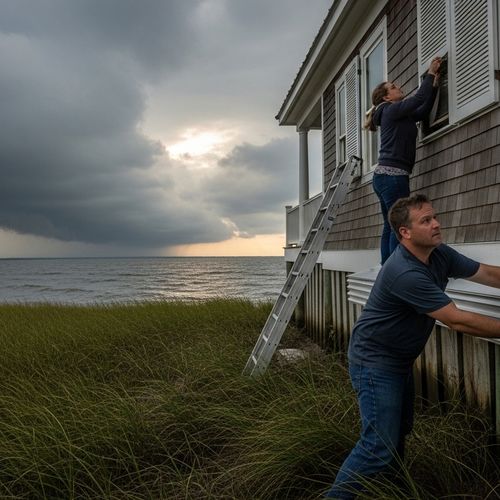
This kind of wording sounds strong, but it should be treated as marketing language until the details are clear. A home is not truly storm-ready because the listing says so.
Buyers should ask what features support that claim. That may include shutters, impact-rated glass, roof improvements, drainage work, or other documented upgrades. FEMA’s flood insurance guidance and the National Association of Realtors’ consumer guide to flood insurance both stress an important point: most homeowners insurance policies do not cover flood damage, so broad sales language should never replace a real review of risk and coverage. For local context, readers may also find value in what I tell my neighbors every year about hurricane season.
What “No Flood Insurance Required” Does Not Mean for Coastal Buyers
This phrase causes a lot of confusion. In most cases, it means flood insurance is not currently required by a lender under existing rules. It does not mean the property has no flood risk.
That distinction matters. On FEMA’s FloodSmart flood-risk guidance, the agency notes that nearly one-third of NFIP flood insurance claims from 2014 to 2024 came from areas outside current high-risk flood areas. The same guidance also states that most homeowners and renters insurance does not cover flood damage. So when a listing says flood insurance is not required, the smart move is to verify the flood zone, ask whether an elevation certificate exists, and get an insurance quote before assuming the risk is low. If you are focused on Carteret County, this article on how hurricane risks affect waterfront home insurance costs in Morehead City is a strong companion read.
Pro Tip: Never translate “not required” into “no risk.” Those are not the same thing.
Why “Buyer to Verify” Is a Signal to Slow Down and Confirm Details
Whenever you see “buyer to verify,” take it seriously. The listing is telling you not to rely on that statement without confirming it yourself.
In coastal real estate, this can apply to square footage, permit history, access rights, dock details, rental use, septic information, and other facts that affect value and usability. This is one reason I often encourage buyers to read why it’s important to work with a Realtor before assuming a listing tells the whole story.
What “Water Views,” “Steps to the Beach,” and “Private Beach Access” May Be Hiding
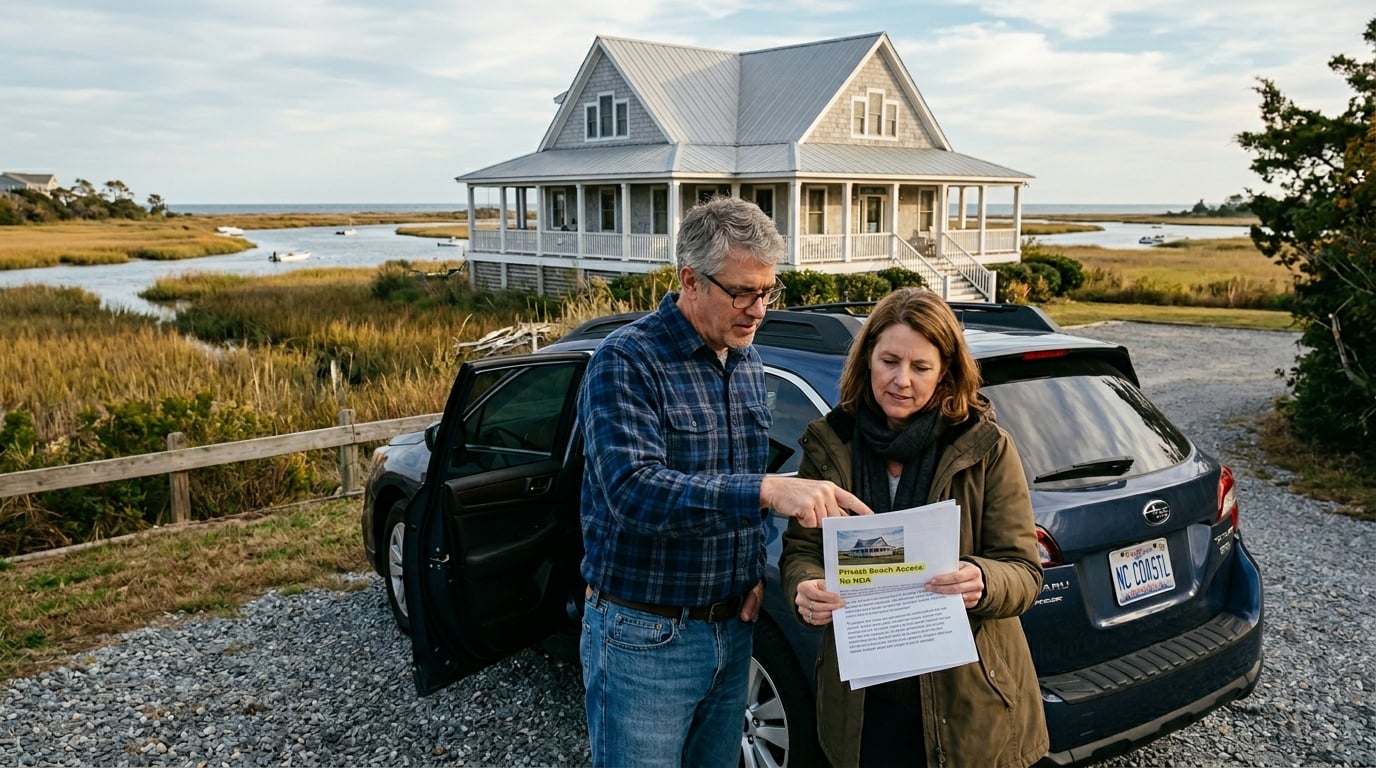
These phrases can sound stronger than they are. “Water views” may be partial or seasonal. “Steps to the beach” may still involve a road, a shared path, or a longer walk than expected. “Private beach access” may refer to deeded access, shared access, or community access described in the best possible light.
That is why buyers should ask what is deeded, what is shared, and what documents support the claim. Readers comparing access should also review how to compare two beach homes with different access types before treating those phrases as interchangeable.
Why “Deep Water Access” Should Lead to Practical Questions
This phrase is especially appealing to boaters. It can also be too vague to rely on without follow-up.
Water depth may vary by tide, channel conditions, maintenance, and nearby limitations. A listing may highlight the feature, but buyers should still ask how usable that access really is in day-to-day life. For buyers zeroing in on boating needs, it helps to review which neighborhoods have the best deep water access for boats.
What “Vacation Rental Friendly” or “Investment Opportunity” Should Prompt You to Verify
These words can attract buyers quickly. Still, they should always trigger one direct question: Based on what rules?
A property may sound like a strong income opportunity, but buyers should confirm current rental rules, local restrictions, community guidelines, and any insurance limitations that affect actual use. If rental income is part of your goal, you may also want to review vacation rental investment properties on the North Carolina coast and this guide to buying vacation rental property in North Carolina.
Why “No HOA” Can Be a Benefit or a Warning Sign
Some buyers love the idea of no HOA, and sometimes that freedom is a real advantage. At the same time, it can mean fewer shared standards, fewer common protections, and less structure around maintenance or neighborhood expectations.
That does not make it bad. It simply means buyers should understand what responsibilities and limitations come with that freedom, especially in coastal neighborhoods where upkeep and access issues can affect long-term value.
Coastal Listing Red Flags Often Appear in What the Listing Leaves Out
Sometimes the real issue is not what the listing says. It is what it avoids saying. A listing with few photos, limited exterior angles, no mention of roof age, no flood-related detail, or no access explanation may leave buyers with an incomplete picture.
That does not prove there is a problem. Still, missing details are often a good reason to ask more questions before scheduling a showing or making assumptions. Zillow’s research on climate-risk home sales adds useful context here: in its June 2024 sample, 52% of high-flood-risk homes sold versus 71% of low-flood-risk homes, and high-flood-risk homes took a median 31 days to reach final pending versus 19 days for low-risk homes. If you are evaluating an area more broadly before drilling into one listing, pages like Beaufort homes for sale, Morehead City homes for sale, Carolina Beach homes for sale, and Oak Island homes for sale can help you compare how similar homes are being presented in the market.
Pro Tip: If a listing gives you plenty of mood and lifestyle language but very few hard facts, treat that as a cue to investigate further.
Smart Questions to Ask When Coastal Listing Language Sounds Vague
When a phrase feels unclear, the best next step is a clear question. Keep it simple.
Ask:
- What does that phrase mean for this property?
- What documents support that statement?
- Has the property had flooding, water intrusion, or storm repairs?
- Which updates were cosmetic, and which were structural?
- What should I verify before relying on this feature?
If you are relocating or buying from a distance, it may also help to review virtual tour Realtors in for remote buyers and Star Team Real Estate’s elite relocation assistance so you can ask those questions early, even before an in-person visit.
Final Thoughts on Reading Between the Lines in Coastal Listings
Coastal homes can offer an incredible lifestyle. But smart buyers know that certain words deserve a closer look. The goal is not to become skeptical of every listing. The goal is to know when to pause, ask better questions, and verify the answers.
At Star Team Real Estate, we believe buyers deserve clear guidance, honest answers, and practical local insight when reading coastal listings. If you want help understanding what a listing really means before you move forward, start with our VIP home search or contact Star Team Real Estate at (252) 727-5656.
Check out this article next